Abstract Woman Face Embroidery Design
A Designer’s Real-World Review for Small Business Merchandise
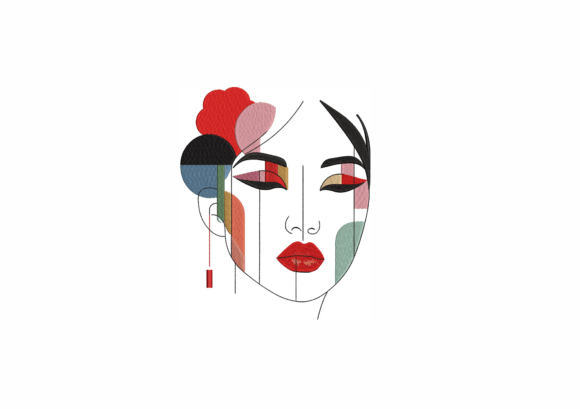
As an embroidery designer who’s developed hundreds of commercial files for boutiques, cafés, florists, pet brands, and handmade studios, I approach every new machine embroidery design with two questions: “Does it translate professionally at scale?” and “Will it strengthen—not distract from—the brand behind it?” When I first saw the Abstract Woman Face Embroidery Design, my instinct was positive: modern line art meets intentional geometry—clean enough for a boutique apron, expressive enough for an Etsy seller’s tote bag mark. It lands firmly in the modern, stylish, and confidently artistic lane—not playful or rustic, not classic or corporate—but contemporary with quiet authority. That makes it unusually versatile for small business merch that wants to feel human-centered without sacrificing polish.
Where This Design Shines in Commercial Use
The Abstract Woman Face Embroidery Design excels where personality matters most: embroidered patches, chest logos on staff uniforms, sleeve accents on work shirts, front-cap embroidery for creative teams, and minimalist tote bag designs. Its balance of open negative space and defined geometric details means it reads clearly—even at 2.5”–3.5” wide—making it ideal for apron embroidery in bakeries or florist shops, where clarity and charm coexist. I’ve used similar abstract face motifs for a local ceramic studio’s employee caps—and customers consistently commented on how “thoughtful” and “uniquely them” the branding felt. That same resonance applies here.
For custom apparel like branded tees or relaxed-fit jackets, this design holds visual weight without overwhelming fabric. Its line-art foundation ensures crisp stitch definition, while the colorful geometric details invite thoughtful thread color selection—think muted terracotta + charcoal for a café, sage + cream for a wellness brand, or cobalt + warm gray for a design studio. As a digital embroidery file, it also adapts well to printable mockups: clients instantly grasp its tone, which speeds up approvals and reduces revision rounds.
Use With Intention—Not Everywhere
That said, the Abstract Woman Face Embroidery Design isn’t universally scalable. On curved surfaces like cap fronts under 2”, fine line work may blur; tight curves in the face outline can distort if pushed too small. Likewise, avoid placing it on highly textured fabrics (like bouclé or heavy burlap) without testing stabilizer combinations first—geometric precision relies on stable fabric tension. High stitch density in the colored facets could cause puckering on lightweight cottons or stretch knits unless paired with cutaway or tear-away stabilizer suited to the base material.
It’s also not ideal for dark uniforms requiring light thread only—unless you’re prepared to adjust contrast deliberately (e.g., using matte metallic or tonal variegated threads). And while beautiful on tote bags and product packaging accents, avoid pairing it with tiny supporting text: the design’s strength is its visual autonomy, not typographic synergy. Let it breathe. Save slogans or shop names for separate, simplified placements.
How It Shapes Brand Identity & Customer Trust
In small business contexts, consistency builds trust—and the Abstract Woman Face Embroidery Design supports that. Its cohesive aesthetic bridges handmade warmth and professional execution. When stitched on a barista’s apron or a florist’s canvas tote, it signals care in curation, not just decoration. Customers subconsciously associate that intentionality with product quality and service reliability. For Etsy sellers or craft-based brands, it elevates perceived value: this isn’t generic clip art—it’s a considered design asset that says, “We invest in our visual language.”
More subtly, its abstract nature invites interpretation without alienating—ideal for inclusive, gender-fluid, or identity-forward brands. Unlike literal portraits, it avoids specificity while retaining humanity. That openness strengthens connection across diverse audiences, especially in beauty-adjacent spaces where authenticity and self-expression are central.
Practical Notes Every Embroidery Designer Should Check
Before committing to production, run these checks:
- Test in black and white first. Does the line art retain legibility? Do geometric shapes hold shape without color cues?
- Verify patch-size performance. Resize to your smallest intended use (e.g., 1.75” for lapel patches) and check for lost detail or stitching gaps.
- Review thread color contrast against your base fabric—especially on dark or saturated materials.
- Inspect spacing between elements. Tight junctions between lines and shapes need clean jump stitches to avoid nesting or thread breaks.
- Confirm hoop size compatibility with your machines—and whether re-hooping is needed mid-design.
- Test on real fabric with your chosen stabilizer. A denim apron behaves very differently than a linen tote.
- Create a physical mockup before client approval—digital previews rarely capture texture, sheen, or drape.
- Compare alongside other design assets (logos, fonts, packaging)—does it harmonize or compete?
- Confirm commercial licensing before use on merchandise for resale. Not all digital embroidery files include blanket commercial rights.
Remember: the Abstract Woman Face Embroidery Design thrives when treated as a strategic element—not just decoration. It belongs on the chest of a boutique owner’s uniform, stitched beside a hand-stamped tag on a ceramic mug, or anchoring the corner of a reusable produce bag at a farmers’ market stall. In each case, it quietly reinforces that this business values both craft and clarity.
Final Thought for Small Business Owners & Embroidery Shops
If your brand lives at the intersection of beauty, creativity, and authenticity—the Abstract Woman Face Embroidery Design isn’t just another embroidery file. It’s a subtle amplifier. Used thoughtfully, it transforms functional items—aprons, caps, totes—into touchpoints that reflect your ethos. For embroidery shops, it’s a high-perception, low-revision asset that clients love to approve. For handmade brands, it adds cohesion without cliché. Just honor its strengths: give it room to breathe, test it rigorously, and let its modern elegance speak for your business—without saying a word.