Colorful Heart Patch Embroidery
A Playful, Confident Heart with Textural Charm
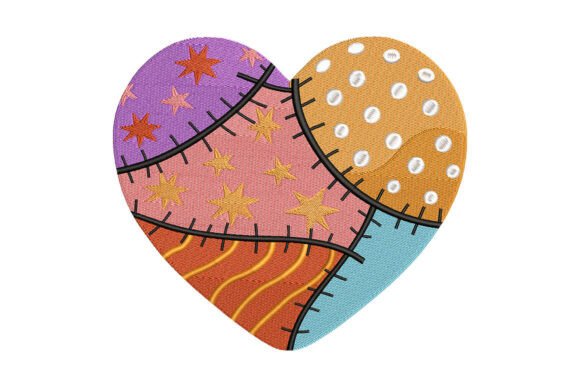
As an embroidery designer who’s stitched hundreds of boutique apparel collections—from limited-run hoodies to curated Etsy drops—I opened Colorful Heart Patch Embroidery expecting sweetness. What I found was more: a bold, rhythmically layered heart built from stitched stars, organic waves, dotted fields, and tactile textured segments—all held together by crisp black outlines. It doesn’t whisper “Valentine S Day.” It sings it—with personality, precision, and just enough whimsy to feel handmade without sacrificing polish. This isn’t a flat appliqué or a minimalist icon—it’s a machine embroidery design with visual weight, dimension, and intentional contrast. The stitch density feels balanced: dense enough to read clearly on garment scale, but breathable enough for soft fleece or lightweight cotton. It lands somewhere between playful and premium—ideal for brands that want warmth without saccharine overload.
How It Performs Across Boutique Apparel
Sweatshirt embroidery is where Colorful Heart Patch Embroidery shines brightest. On a neutral heather grey or oatmeal sweatshirt, the color blocks pop without clashing—especially when you match thread tones to your brand palette (think mustard stars, dusty rose waves, sage dots). For hoodie design, chest placement reads cleanly at 3.5–4 inches wide; sleeve accents work beautifully at 2.25 inches, letting the segmented heart wrap naturally around the curve. As a back design on oversized hoodies? It holds attention without overwhelming—its asymmetrical patchwork layout avoids stiffness, giving movement even in static photos.
On t-shirts, I recommend using it as a subtle left-chest accent—not center-front—so the texture reads as intentional detail, not decoration overload. With denim jackets, it adds unexpected joy: try it above the right pocket or on the back yoke. For tote bag design, scale up slightly (within Creative Fabrica’s resizing limits) to let the star-and-wave segments breathe across canvas. And yes—it works on cozy seasonal layers: layer it over chunky knit cardigans or thermal-lined loungewear. Just avoid placing it directly over heavy seams or thick ribbing unless you’ve tested stabilizer support first.
Where to Use It Thoughtfully
This embroidery file has personality—but that means thoughtful placement matters. Its black outlines are strong, so on very dark garments (navy, charcoal, black), confirm your thread colors retain enough contrast in natural light—not just on screen. On stretchy fabric like cotton-spandex blends or brushed French terry, use medium-weight cutaway stabilizer underneath and a light tear-away on top to prevent puckering in the wave and dot zones. Avoid placing it over high-movement areas like underarms or curved shoulder seams unless you’ve done a wear-test: the textured segments can shift subtly after washing if stabilization is light.
Because the design includes fine stitched details (tiny stars, narrow wave lines), skip ultra-soft fleece with deep pile—it can swallow definition. Ribbed fabric? Test first: the outline holds, but dense ribs may compress some textured fills. And while the heart shape is forgiving, don’t shrink it below 2.75 inches—stars and dots lose legibility, weakening its custom apparel impact.
Why It Elevates Your Boutique Brand
For Etsy sellers and small shop product lines, Colorful Heart Patch Embroidery does quiet brand-building work. It signals care—not just in stitching, but in curation. Customers scrolling lifestyle product photos instantly recognize a cohesive, human-made aesthetic. That visual consistency builds buyer trust: when your sweatshirt collection uses the same heart motif across colors and styles, shoppers begin associating that joyful texture with your boutique brand. It also boosts customer engagement—people tag friends in comments like “This is *so* you!” because the design feels personal, not mass-produced. In mockups, it photographs exceptionally well: the black outlines ensure clarity in printable mockups and social media graphics, even at thumbnail size. That translates directly to stronger Etsy listings and higher click-throughs on Instagram carousels.
Practical Notes Every Embroidery Designer Should Check
- Test on scrap fabric—especially if using new thread brands or unfamiliar garment blanks. Stitch density shifts subtly across machines.
- Review stabilizer choice carefully: cutaway for knits and fleece, medium-weight tear-away for stable cottons and denim.
- Confirm hoop size before digitizing adjustments—the original digital embroidery file may require a 5x7 or larger hoop depending on final scale.
- Inspect thread color contrast on your actual fabric swatch, not just the screen preview. Dyes behave differently under studio lighting.
- Compare placement options on a garment mockup: chest, sleeve, back yoke, and even pocket flap each create distinct brand impressions.
- Check Creative Fabrica product details thoroughly—especially licensing terms—before producing finished apparel for resale. Some designs allow commercial embroidery; others have usage limits.
- Test on similar garment fabric before bulk production. A 100% cotton hoodie behaves differently than a poly-cotton blend—even with identical stabilizer.
Final Thought: More Than a Valentine S Day Design
Yes, Colorful Heart Patch Embroidery fits perfectly into February collections—but its real strength lies in longevity. That textured, segmented heart reads as joyful year-round: think spring markets, summer camp merch, fall gift sets, or cozy holiday bundles. It’s versatile enough for commercial embroidery shops serving local boutiques, yet distinctive enough for independent makers building a signature look. When executed well—with smart stabilizing, intentional thread choices, and confident placement—it transforms simple apparel into memorable handmade product. Not just something people wear—but something they remember, share, and reach for again.